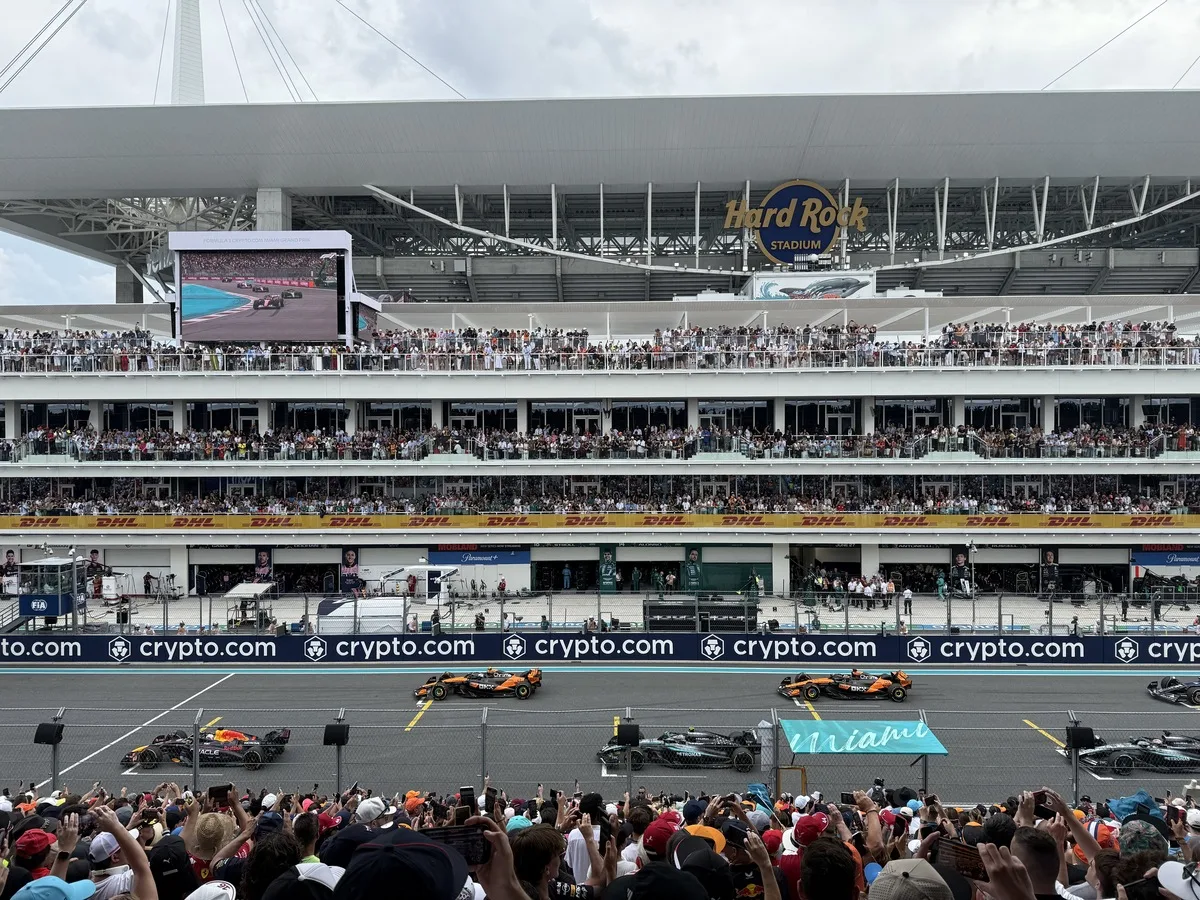
Miami is the first real stress test for the championship pricing established across the opening three rounds. After Australia, China, and Japan handed Mercedes and Kimi Antonelli the early narrative, the Miami International Autodrome introduces a different set of variables: a semi-street circuit with aggressive tire degradation, high-speed sequences that load the 2026 active aerodynamics in unusual ways, and a Saturday-to-Sunday delta that has historically been wider here than at any other permanent track on the calendar.
The betting template for Miami is not about which car was quickest across a weekend. It is about which team understood the tire window on a surface that does not behave like a conventional circuit, and whether that understanding is already reflected in the pre-race line.
Why Miami produces atypical pricing conditions
The Miami International Autodrome is built on asphalt that was originally a parking structure. That surface has less macro-texture than a traditional racing circuit, which means tire compounds heat and wear through abrasion rather than the mechanical grip cycle. In 2026, with the active aero packages generating more downforce variation through medium-speed corners, that surface behaviour becomes even more pronounced.
The practical betting implication: qualifying pace is less predictive here than at Bahrain, Saudi Arabia, or the Japanese circuits. Teams that can manage rear tire temperatures through the lap's middle sector often produce a race pace that looks disproportionately stronger than Saturday suggested. The market does not always fully price this, especially after a run of weekends where the pole-sitter has consistently converted to the win.
Tire wear as the first betting lever
Miami has produced at least one unexpected podium finisher in four of the last six runnings. The mechanism is usually the same: a team that qualifies outside the top four manages a longer first stint, benefits from a compressed safety-car window, and arrives at the mandatory pit stop window in a position the pre-race market did not price.
In 2026, the medium compound is likely to be the primary strategic pivot. Teams that can demonstrate medium-stint management in practice, rather than simply chasing a time trial on fresh softs, are the ones worth watching in the H2H and podium finish markets. This is particularly relevant for drivers running the newer 2026 power units who have shown ability to deploy energy strategically rather than in sustained bursts.
The 2026 aero package and the Miami effect
Active aerodynamics in 2026 add a dimension that previous Miami markets did not price. The variable-drag systems generate their biggest efficiency gap on the long DRS detection zones at turns 1–3 and on the short straight before the marina complex. Teams that understand how to configure their aero for maximum deployment efficiency through those zones rather than simply for maximum peak speed will have an advantage that is almost impossible to detect from Saturday timing sheets.
That information gap is where betting value can sit. When a team's race engineer has developed a clear aero deployment map for a specific circuit type, the outright race winner market and the head-to-head constructor markets are often slow to reflect it because the signals only show up in race telemetry, not qualifying data.
Qualifying-to-race conversion: the Miami discount
The standard Bettista template for any Formula 1 weekend asks: how much should you discount qualifying pace for the race market? At Miami, that discount is larger than average. The historical qualifying-to-race pole conversion rate at Miami is below 50% when adjusted for safety car randomness. That means you should expect the race market to re-price meaningfully between Friday practice and the Sunday pre-race window.
Bettors who wait for race morning to price the race — using qualifying telemetry to assess true pace rather than lap times — are systematically better positioned here than those who react to Saturday results. The qualifying result is a useful data point, but it is not a reliable predictor of the race outcome at a circuit where tire management over 57 laps is the dominant variable.
Podium value and the constructors' picture
If the championship picture entering Miami is a Mercedes-led narrative, the relevant question for podium betting is not whether that narrative continues — it probably does — but where the value sits across positions 2 through 5. Historical Miami results suggest at least one non-Mercedes car typically reaches the podium. In 2026, the constructors with the technical profiles best suited to the Miami surface — teams that have shown measured long-run pace in warm-weather tire conditions — deserve a closer look at podium prices that remain longer than the outright winner market suggests.
Specifically: Red Bull and Ferrari have each shown consistent pace in conditions that mirror Miami's thermal surface characteristics during pre-season testing. The market, which tends to price the champion's team heavily after a winning run, may be leaving value in a Ferrari or Red Bull podium finish that a pure qualifying read would undervalue.
What to carry forward after Miami
Miami's result matters as a data point for circuit-type pricing. If Mercedes extend their winning run here on a circuit where tire management is king, the championship price becomes structurally harder to beat into Monaco. If a rival team takes the win or an unexpected podium finisher appears, that tells you the 2026 power unit and aero combination is more balanced across circuit types than the opening European run will have suggested.
The practical takeaway is to carry the Miami tire data into your Miami Sprint Saturday pricing framework and into the Emilia Romagna pre-race market, where surface characteristics shift back toward conventional asphalt and the same teams should produce the same relative hierarchy — unless Miami revealed a specific setup flaw that travels beyond the circuit type.